
What Makes a Bimetal Thermometer Essential for Industrial Applications?
2026-01-16
Summary: Understanding accurate temperature measurement is crucial in many industrial processes. The bimetal thermometer, based on the principle of thermal expansion of metals, offers reliability, durability, and precision. This article explains how it works, its types, applications, and factors to consider when choosing one, helping industrial professionals make informed decisions.
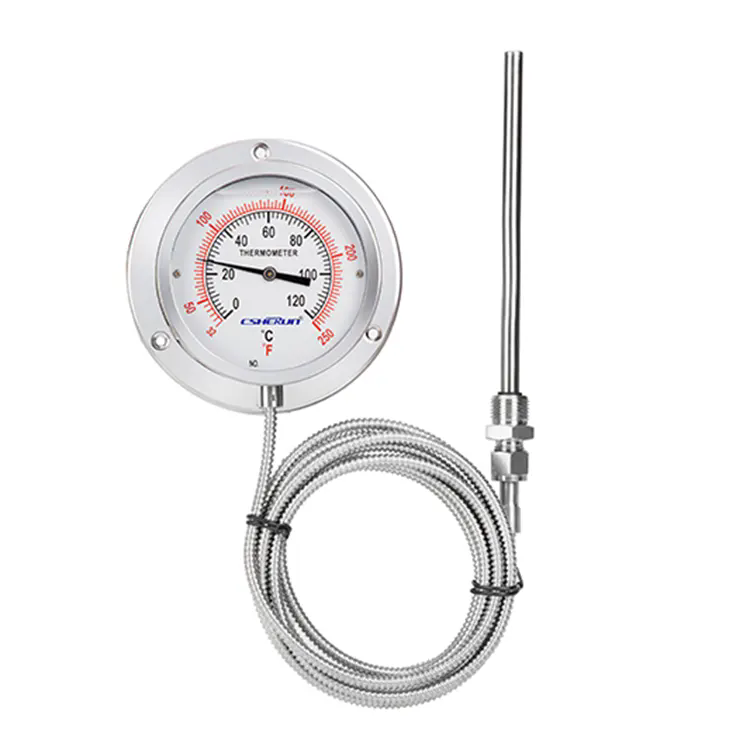
Table of Contents
- Working Principle of a Bimetal Thermometer
- Types of Bimetal Thermometers
- Key Industrial Applications
- Factors to Consider When Selecting a Bimetal Thermometer
- Technical Specifications
- Frequently Asked Questions
- Contact Information
Working Principle of a Bimetal Thermometer
A bimetal thermometer measures temperature using two bonded metals with different linear expansion rates. When temperature changes, the metals expand or contract differently, causing the bimetallic strip to bend. This bending movement rotates a pointer on the dial, providing a visual representation of the temperature.
Key features include:
- Medium to low temperature measurement: -80℃ to 500℃
- Intuitive, easy-to-read display
- High mechanical strength
- Corrosion and vibration resistance
- Long-term durability and safety
Types of Bimetal Thermometers
Bimetal thermometers are designed in multiple structural forms to meet specific industrial needs:
| Type | Description | Common Use |
|---|---|---|
| Axial | Pointer aligned along the stem axis | Pipe or tank surface temperature measurement |
| Radial | Pointer perpendicular to the stem axis | Easy reading in constrained spaces |
| Universal | Adjustable orientation of pointer | Flexible installation for various equipment |
Installation styles also vary:
- Movable external threads
- Fixed threads
- Ferrule threads
- Flanged mounting
Key Industrial Applications
Bimetal thermometers are widely used in industries where precise temperature control is essential. Typical applications include:
- Petrochemical Industry: Monitoring temperature in pipelines and reactors
- Chemical Industry: Ensuring safe and accurate temperature readings in processing equipment
- Food & Beverage: Maintaining consistent product quality during heating or cooling
- HVAC Systems: Temperature management in air handling units and boilers
- Power Plants: Measurement in steam lines and auxiliary equipment
Factors to Consider When Selecting a Bimetal Thermometer
Choosing the right bimetal thermometer requires attention to specific parameters:
| Factor | Details |
|---|---|
| Accuracy | Levels: 0.25, 0.5, 1.0, 1.5 (industrial applications commonly use 1.5) |
| Temperature Range | Choose based on minimum and maximum expected temperatures (-80℃ to 500℃) |
| Protection Level | IP55 or higher recommended for harsh industrial environments |
| Response Time | Typically below 40 seconds for bimetal thermometers |
| Material & Corrosion Resistance | Stainless steel stem and casing for chemical resistance |
Technical Specifications
- Pointer type: Single or dual for multi-range measurement
- Dial diameter: 50mm, 63mm, 100mm depending on visibility requirements
- Stem length: Customizable according to application depth
- Operating conditions: Stable performance in high vibration and moderate pressure
- Certifications: EN13190 compliance for industrial quality assurance
Frequently Asked Questions
Q1: How do I maintain a bimetal thermometer?
A1: Ensure periodic calibration, clean the stem, and avoid mechanical shocks to maintain accuracy and prolong service life.
Q2: Can a bimetal thermometer be used in high-pressure systems?
A2: Yes, if combined with protective fittings like thermowells, it can withstand pressure environments safely.
Q3: What industries benefit most from bimetal thermometers?
A3: Petrochemical, chemical, food & beverage, HVAC, and energy sectors rely heavily on accurate bimetal temperature measurements.
Contact Information
CSHERU is a trusted manufacturer of high-quality bimetal thermometers. Every thermometer is designed to ensure precision, durability, and reliability in demanding industrial applications. To learn more about customized solutions or bulk orders, contact us today for professional assistance.