
What are the key wiring steps for installing an AC Type 2P RCCB correctly
2026-04-08
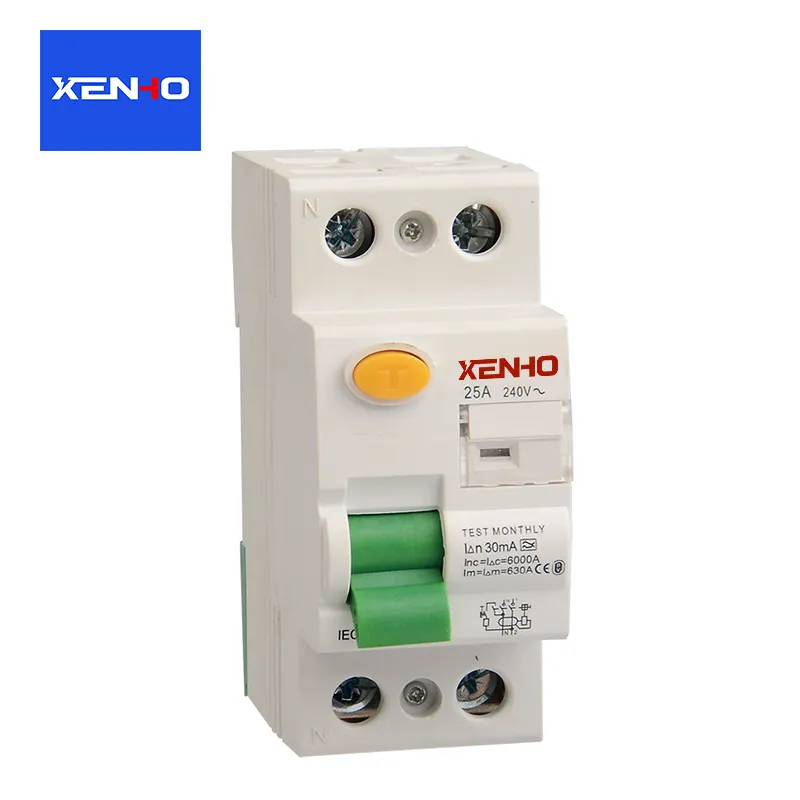
Installing an AC Type 2P RCCB correctly is critical for ensuring electrical safety in single‑phase residential and light commercial systems. The AC Type 2P RCCB is designed to detect residual currents (earth leakage) in AC circuits and disconnect both poles simultaneously. A poor wiring job can render the device useless or create fire hazards. Below, XENHO provides a professional, step‑by‑step guide to correct installation, followed by essential FAQs and a clear call to action.
Required Tools and Components
| Tool/Component | Specification |
|---|---|
| AC Type 2P RCCB (from XENHO) | Rated current (e.g., 25A, 40A), sensitivity (e.g., 30mA), AC type |
| Voltage tester | Non‑contact or two‑pole tester |
| Flathead & Phillips screwdrivers | Insulated, VDE certified |
| Wire strippers | For 1.5mm² to 6mm² conductors |
| Torque screwdriver | To avoid overtightening |
| DIN rail (35mm) | Standard mounting rail |
Six Key Wiring Steps
| Step | Action | Critical Check |
|---|---|---|
| 1 | Power off the main incoming supply. Verify absence of voltage with a tester. | Zero voltage at line terminals |
| 2 | Mount the XENHO AC Type 2P RCCB onto a 35mm DIN rail. Ensure it clicks securely. | No wobble; device upright |
| 3 | Identify terminals: Top side = Line (supply) input. Bottom side = Load (protected circuit) output. | Read labels: "Line" and "Load" |
| 4 | Connect incoming live (brown/grey) and neutral (blue) to top terminals. Torque to manufacturer’s value (usually 2.0‑2.5 Nm). | No copper strands exposed |
| 5 | Connect outgoing live and neutral to bottom terminals, leading to the protected circuit. | Correct polarity: live to live, neutral to neutral |
| 6 | Label the circuit and restore power. Press the "Test" button monthly. | RCCB trips immediately on test |
⚠️ Never reverse line and load on an AC Type 2P RCCB – internal electronics may be damaged.
AC Type 2P RCCB FAQ – Common Professional Questions
Q1: Can I use an AC Type 2P RCCB with a generator or UPS system?
A: Yes, but only if the generator or UPS produces a pure sine wave output. Modified sine wave inverters can cause nuisance tripping because the AC Type 2P RCCB detects residual currents based on a smooth AC waveform. For non‑sinusoidal sources, XENHO recommends testing compatibility first or switching to an A‑Type RCCB. Always install the RCCB on the load side of the UPS, never between the UPS and its battery.
Q2: Why does my AC Type 2P RCCB trip randomly even with no apparent fault?
A: Random tripping usually indicates cumulative earth leakage from multiple appliances (e.g., old refrigerators, washing machines, heating elements). First, use a leakage clamp meter to measure total residual current. If it exceeds 15mA (half of a 30mA rating), individual circuits must be split. Second, check for water ingress in outdoor junction boxes. Third, ensure the neutral from the protected circuit is not shared with any other RCCB – that creates a parallel path causing imbalance. XENHO provides high‑immunity AC Type 2P RCCB models resistant to transient voltage spikes.
Q3: Does the AC Type 2P RCCB require a separate neutral bar for the output side?
A: Yes. The outgoing neutral wire from the bottom terminal of the AC Type 2P RCCB must go directly to a dedicated neutral bar for the protected sub‑circuit. It cannot be connected to the main incoming neutral bar. If multiple AC Type 2P RCCB units are used in a distribution board, each must have its own independent neutral bar. Mixing neutrals will cause immediate and continuous tripping because the RCCB will see an imbalance even with no load.
Best Practices for Long‑Term Reliability
| Practice | Why It Matters |
|---|---|
| Use ferrule ends on stranded wires | Preents stray strands from loosening |
| Perform trip test every 6 months | Confirms mechanical and electronic integrity |
| Install surge protection upstream | Reduces damage from lightning or switching surges |
Contact XENHO for Professional Support
Correct installation of an AC Type 2P RCCB is only the first step. For technical datasheets, wiring diagrams, or bulk purchasing assistance, contact XENHO today through our official website or your local distributor. Our engineers provide remote troubleshooting and certified training materials to ensure your electrical systems remain safe and compliant.