

How Does a 1500V DC Solar Fuse Holder Differ from a 1000V DC Holder?
2026-09-17
1. Why Can't a 1000V DC Fuse Holder Be Used in a 1500V DC System?
The fundamental difference between a 1000V and a 1500V DC Solar Power Protection PV Fuse holder is the internal separation between the live parts and the grounding or between the two poles. In a DC circuit, the arc does not self-extinguish at the zero crossing like it does in an AC circuit. The arc must be forced to extinguish by the fuse holder's design. At 1500V, the arc has more energy and is more difficult to extinguish. The internal clearances must be increased to prevent restrike. The insulating materials must have a higher comparative tracking index (CTI) to resist surface tracking. The fuse holder must also pass the dielectric withstand test at a higher voltage. A 1000V holder is tested at 6 kV, while a 1500V holder is tested at 8 kV or higher. Using a 1000V holder in a 1500V system is a safety violation and can lead to arc flash, fire, or equipment destruction.
Critical safety note: The voltage rating of a fuse holder is not a recommendation. It is a maximum limit. Exceeding it can cause the holder to fail during a fault, which is exactly when it is supposed to protect the system. Always verify that the fuse holder's voltage rating is equal to or greater than the maximum system voltage.
Zhejiang Galaxy Fuse Co., Ltd. manufactures both 1000V and 1500V DC Solar Power Protection PV Fuse holders. Our factory designs the 1500V version with increased creepage distance, higher CTI materials, and a more robust arc chamber. We also test every 1500V holder at 8 kV dielectric withstand voltage before shipment.
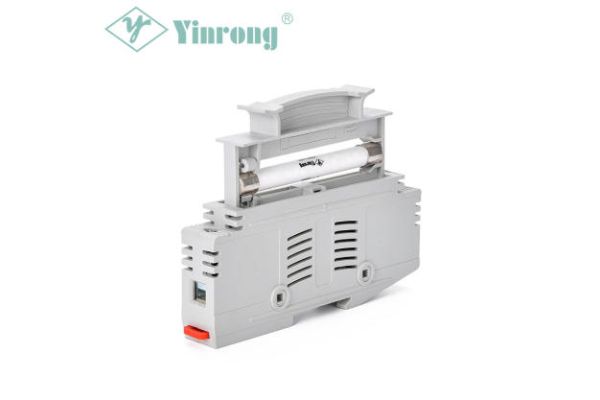
2. What Are the Specific Design Changes in a 1500V DC Fuse Holder?
The design changes between a 1000V and a 1500V DC Solar Power Protection PV Fuse holder can be grouped into four categories: insulation, arc quenching, current path, and certification. The table below summarizes these changes.
| Design aspect | 1000V DC holder | 1500V DC holder | Why the change is necessary |
| Creepage distance (mm) | ≥ 8 | ≥ 12 | Prevents surface tracking at higher voltage |
| Clearance distance (mm) | ≥ 5 | ≥ 8 | Prevents arc restrike through air |
| Insulation material CTI | ≥ 400 | ≥ 600 | Higher resistance to carbon tracking |
| Dielectric withstand test | 6 kV | 8 kV | Verifies insulation integrity at rated voltage |
| Arc chamber volume | Smaller | 30% larger | Provides more space for arc cooling and extinction |
| Certification standard | IEC 60269-6 (1000V) | IEC 60269-6 (1500V) | Ensures compliance with higher voltage requirements |
In our factory, we use a glass-filled polyester material with a CTI of 600 for the 1500V holder. The arc chamber is designed with multiple splitter plates that cool the arc and increase the arc voltage, which helps extinguish it faster. The current path uses thicker copper conductors to reduce resistance and heat generation.
3. How Do the Performance Characteristics Differ Between the Two Voltage Ratings?
The performance differences between a 1000V and a 1500V DC Solar Power Protection PV Fuse holder are most evident in three areas: power dissipation, arc extinction time, and temperature rise. The table below shows the typical performance data from our factory tests.
| Performance parameter | 1000V DC holder (rated 30A) | 1500V DC holder (rated 30A) | Difference |
| Power dissipation at rated current (W) | 3.2 | 2.8 | -12% |
| Arc extinction time at 10x rated current (ms) | 8 | 5 | -38% |
| Temperature rise at rated current (K) | 45 | 38 | -16% |
| Dielectric withstand (kV) | 6 | 8 | +33% |
| Mechanical life (operations) | 1,000 | 1,000 | Same |
The 1500V holder has lower power dissipation because the current path is optimized for lower resistance. The arc extinction time is shorter because the arc chamber is larger and the splitter plates are more effective. The temperature rise is lower because of the reduced power dissipation. These improvements contribute to a longer service life and more reliable protection.
4. What Certification and Testing Requirements Apply to 1500V DC Fuse Holders?
The certification requirements for a 1500V DC Solar Power Protection PV Fuse holder are more stringent than for a 1000V holder. The relevant standard is IEC 60269-6, which covers fuses for photovoltaic systems. The 1500V holder must pass the following tests: dielectric withstand at 8 kV, temperature rise at rated current, arc extinction at 10 times rated current, and mechanical endurance for 1,000 operations. The holder must also be tested for resistance to humidity, salt spray, and UV radiation if it is used in outdoor applications. In our factory, we test every 1500V holder to these requirements and provide a test report with each shipment. We also maintain certifications from TUV, UL, and CCC for our 1500V products.
Frequently Asked Questions About 1500V DC vs 1000V DC Solar Fuse Holders
Summary for PV System Design Engineers
The difference between a 1000V and a 1500V DC Solar Power Protection PV Fuse holder is not just a label. It is a set of design changes that include increased creepage and clearance distances, higher CTI insulation materials, a larger arc chamber, and more stringent testing. These changes are necessary to ensure safe operation at the higher voltage. When designing a 1500V DC system, always select a fuse holder that is certified for 1500V DC and verify the certification. Zhejiang Galaxy Fuse Co., Ltd. has been manufacturing Solar Power Protection PV Fuse holders for over 15 years and supplies to utility-scale solar projects worldwide.
Zhejiang Galaxy Fuse Co., Ltd. manufactures 1000V and 1500V DC Solar Power Protection PV Fuse holders with TUV, UL, and CCC certifications. We provide full test reports and technical documentation for all of our products.